Updated: July 2026
Sunrise vs Sunset: The Best Luxury Borobudur Temple Experience
- Private Access: Utilizes special arrangements to ensure a more intimate viewing, avoiding the peak visitor surges.
- Expert Guidance: Employs university-level art historians or archaeologists to decode the temple’s complex narrative reliefs.
- Seamless Logistics: Includes private, air-conditioned transport and handles the complex new ticketing and access protocols.
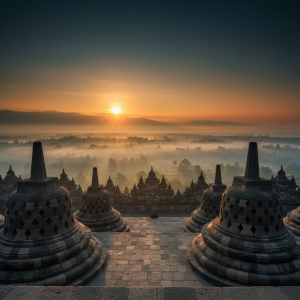
The air is cool, still holding the memory of the night. Underfoot, the dark volcanic andesite stone feels ancient, worn smooth by a millennium of pilgrims. It is 4:45 AM on the Kedu Plain in Central Java, and the world is hushed in anticipation. As you ascend the nine platforms of Borobudur in the pre-dawn quiet, the surrounding jungle begins to stir with a soft chorus. This is not merely sightseeing; it is an immersion. The question for the discerning traveler is not if you should experience this monument during the golden hours, but which golden hour offers the most profound connection. The dramatic reveal of sunrise or the contemplative glow of sunset? As a travel editor, I’ve seen this debate play out in the world’s most rarefied settings, from the Serengeti to Machu Picchu. Here at Borobudur, the choice defines the very character of your encounter with one of humanity’s greatest spiritual achievements.
The Enduring Allure of Borobudur’s Golden Hours
To understand the magnetic pull of Borobudur at dawn and dusk, one must first appreciate the monument’s sheer scale and purpose. This is not a temple in the conventional sense; it is a three-dimensional mandala, a Buddhist guide to enlightenment rendered in two million blocks of stone. Constructed during the reign of the Sailendra Dynasty around 800 AD, it predates Cambodia’s Angkor Wat by some 300 years. Its structure is a marvel of cosmology, comprising six square platforms, three circular platforms, and a magnificent central stupa at its apex. According to its UNESCO World Heritage designation, the temple is decorated with 2,672 relief panels and 504 Buddha statues. It is a textbook in stone, illustrating Buddhist scriptures and Javanese life from a time long past. The golden hours—the brief periods just after sunrise and before sunset—are when this textbook comes alive. The low, angular light rakes across the stone, breathing life into the intricate carvings and casting dramatic, elongated shadows that accentuate the geometry of the 72 bell-shaped stupas on the upper terraces. This interplay of light and shadow is what photographers and pilgrims alike have sought for generations. It is a fleeting performance, lasting less than an hour, where the monument’s spiritual weight feels most palpable, transforming it from an archaeological site into a living, breathing place of immense power.
The Sunrise Experience: An Ascetic’s Pilgrimage in Silk
The Borobudur sunrise has long been the most coveted ticket in Indonesian travel. It is an experience rooted in drama and revelation. The journey begins in the dark, a silent ascent that feels deeply personal, almost monastic. In years past, this meant a special ticket through the grounds of the Manohara hotel, but the process has evolved. Today, a premier Borobudur Luxury Tour — Private Sunrise & VIP Heritage experience means your guide has navigated the new, complex booking system to secure one of the limited daily slots to ascend the monument. You are provided with special *upanat* sandals, a respectful and practical measure to protect the ancient stones. As you climb, the sky shifts from inky black to a deep indigo, then to a soft violet. The moment of truth arrives as the sun crests the horizon, often silhouetting the twin volcanic peaks of Mount Merapi and Mount Merbabu. A sea of mist frequently blankets the surrounding plains, making the temple feel as if it’s floating in the clouds. The light is cool and sharp, ideal for capturing that iconic, wide-angle photograph. It is a shared, yet deeply individual, moment of awe. The experience is active, a pilgrimage rewarded with a spectacular visual climax that energizes you for the day ahead.
The Sunset Experience: A Contemplative Descent into Gold
If sunrise is a dramatic overture, sunset is a soulful adagio. It is an experience that favors reflection over revelation. Arriving in the late afternoon, the heat of the day has begun to dissipate, and the atmosphere is altogether different. The light is not sharp and revealing, but warm, thick, and golden. It bathes the stone in a rich, honeyed hue, imbuing the monument with a sense of peace and finality. This is the time to focus on the micro-details. The warm light is perfect for appreciating the nuance of the bas-reliefs that spiral for nearly five kilometers around the temple’s galleries. You can trace the stories of the Lalitavistara, which depict the life of the Buddha, and see the texture in the stone, the subtle expressions on the faces of figures carved 1,200 years ago. According to the official site indonesia.travel, these panels are a key part of the pilgrim’s meditative journey. The sunset experience is less about the grand, panoramic photograph and more about quiet observation. The descent from the temple as the sky turns from orange to pink is a slow, meditative process. You feel the day’s energy seeping away, replaced by a profound tranquility. It is a more intimate affair, often with fewer visitors than the sunrise slot, allowing for unhurried exploration and a deeper, more personal connection with the spiritual narrative of the structure.
Beyond the Stupas: The Anatomy of a True Luxury Tour
Choosing between sunrise and sunset is just the first step. The true measure of the best luxury Borobudur temple experience lies in the curation and execution of the visit. A standard tour gets you to the gate; a luxury expedition immerses you in the monument’s soul. This begins with your guide. We do not work with script-readers; our partners are academics, historians, and archaeologists who can provide a graduate-level interpretation of the temple’s iconography, architectural provenance, and its place within the socio-political landscape of the Mataram Kingdom. They can explain the difference between the Dhyani Buddhas facing the four cardinal directions and their corresponding *mudras* (hand gestures). A bespoke Borobudur Luxury Tour — Private Sunrise & VIP Heritage also means seamless, private transportation from your residence, perhaps the nearby Amanjiwo or Plataran Heritage Borobudur. There are no crowded buses or logistical hassles. Following the temple visit, the experience is extended. Instead of a generic hotel buffet, imagine a private breakfast of local delicacies set up in a secluded garden overlooking the temple, or a traditional *tiffin* lunch served at a private viewpoint. This level of service transforms a few hours at a historic site into a cohesive, enriching, and utterly stress-free day. It is this meticulous attention to detail that defines a genuine borobudur luxury journey.
Logistics and Exclusivity: Navigating the New Borobudur
It is crucial for the modern traveler to understand that visiting Borobudur has changed significantly. In a commendable effort to preserve the monument, as of 2022, access to the upper platforms—the temple structure itself—is no longer a simple matter of buying a ticket at the gate. The number of visitors allowed to ascend is now capped at just 1,200 people per day, divided into hourly slots. The price for this privilege has also been adjusted, costing foreign visitors approximately 750,000 IDR (around $50 USD). This is where a high-end operator proves its worth. Securing these limited slots requires advance planning and navigating a local booking system. A top-tier expedition company handles this entire process. Furthermore, they provide the context for these changes, explaining the conservation science behind limiting foot traffic on the delicate andesite blocks. They also manage the requirement of being accompanied by a temple-appointed guide and wearing the protective *upanat* sandals. A luxury experience means you are insulated from these bureaucratic hurdles. Your expert private guide works in concert with the mandatory temple guide, ensuring your experience is enriched, not diluted. This insider knowledge is what separates a smooth, enlightening visit from a potentially frustrating one, ensuring your precious time is spent absorbing the wonder of the site, not wrestling with its administration.
Quick FAQ: Your Borobudur Questions Answered
Is climbing to the top of Borobudur still possible?
Yes, but it is now a restricted and more exclusive experience. Access to the temple’s nine platforms requires a special ticket, which is limited to 1,200 visitors per day and must be booked in advance. A luxury tour operator will secure these passes for you as part of their service.
What is the dress code for a luxury Borobudur tour?
The dress code is one of respect. Shoulders and knees should be covered. While sarongs are provided at the entrance, it is best to arrive in lightweight, breathable trousers or a long skirt and a top with sleeves. Comfortable footwear is essential, though you will be required to wear the provided *upanat* sandals when on the temple structure itself to protect the stone.
How far is Borobudur from Yogyakarta and what is the best way to travel?
Borobudur is located approximately 40 kilometers (25 miles) northwest of Yogyakarta. The journey by road typically takes between 60 and 90 minutes, depending on traffic. The best, and by far the most comfortable, way to travel is via a private, air-conditioned vehicle arranged by your tour provider, which eliminates the stress of navigation and parking.
Can I visit both Borobudur and the nearby Prambanan temple in one day?
Absolutely. A popular and highly recommended itinerary combines a Borobudur sunrise with an afternoon visit to the magnificent Hindu temple complex of Prambanan, located about 50 kilometers away. A well-planned Borobudur Luxury Tour — Private Sunrise & VIP Heritage can orchestrate this dual-UNESCO site day seamlessly, including a refined lunch stop between the two locations.
Ultimately, whether you choose the nascent light of dawn or the gilded warmth of dusk, the experience is profoundly personal. The sunrise offers a sense of renewal and dramatic scale, a powerful shared spectacle. The sunset provides a quieter, more intimate communion with the art and spirit of the monument. Neither is superior; they are simply different movements in the same magnificent symphony. The true luxury is not in the time of day, but in having the freedom and expert support to experience Borobudur on your own terms, allowing its ancient wisdom to resonate without distraction. A thoughtfully curated borobudur luxury expedition ensures that whichever light you choose to see it in, the memory will be indelible.
To craft your own perfect encounter with this wonder of the world, explore the bespoke journeys offered by Borobudur Luxury Expeditions. We specialize in creating private, insightful, and memorable experiences at the heart of Javanese culture.